Showing posts with label painting. Show all posts

Thursday, October 12, 2017

Michelangelo famous paintings

Michelangelo was one of the greatest sculptors and painters in Europe. He was also an architect of churches, places and fortress.

Among Michelangelo famous paintings including:
  • The Entombment c. 1500 – 1501 
  • Doni Tondo (The Holy Family) c. 1503 – 1506 
  • The Battle of Cascina 1504 
  • Sistine Chapel ceiling 1508–1512. One of the panels of the ceiling is The Creation of Adam 
  • The Last Judgment 1534–1541 
  • Leda and the Swan c. 1530 
  • The Conversion of Saul c. 1542 – 1545 
  • The Crucifixion of St. Peter c. 1546 – 1550
The Crucifixion of St. Peter
Frescoes are made by paining on fresh, wet plaster. Michelangelo did most famous fresco in history. Pope Julius II gave his the job of repainting the ceiling of the Sistine Chapel with scenes from the Bible. It took years for Michelangelo to finish this masterpiece (1508-1512).
Michelangelo famous paintings

Monday, February 6, 2017

La Scapigliata by Leonardo da Vinci

The Lady of the Dishevelled Hair also known as La Scapigliata, this painting days from approximately 1490 and is housed in the Galleria Nazionale of  Parma.

This work was left unfinished and was mentioned for the first time in the House of Gonzaga collection in 1627.

The painting is made with earth, amber and white lead on wood panel, but the woman’s expression is so romantic and pretty.
La Scapigliata by Leonardo da Vinci 


Thursday, June 18, 2015

L’Absinthe by Edgar Degas

This is the several paintings depict Parisian bohemian life at the end of the 19th century.

Absinthe, is a clear, anisette flavored liquor extracted from the herb wormwood, Artemisia Ansinthium, which was widely consumed by bohemians, artist and writers on the France of the XIX century.

L’Absinthe by Edgar Degas is the most famous painting depicting the intoxicating effect of Absinthe. L’Absinthe in 1876; portrays two people at nearby tables whose isolation and loneliness are apparent and it was widely criticized for its theme and composition.

Originally the name of the painting entitled Dans un Café. The man in the paintings is a friend of Degas called Marcelline Desboutin, who was an artist himself and had studied under Couture.

Desboutin is not even drinking absinthe the brown drink front of him has been identified as black coffee in a glass tumbler, a so-called ‘Mazagran’.

The place was a Parisian Café Nouvelle Athenes in Place Pigalle.
L’Absinthe by Edgar Degas

Saturday, May 23, 2015

Jack-in-the-Pulpit no IV (1930) by Georgia O’Keeffe

In 1930 the American painter Georgia O’Keeffe (1887-1986) produced a series of paintings of flowering plants.

Georgia O’Keeffe was one of the few figures in American art during the 1920s and 1930s who painted in her own way, unlike painted in Europe.

One of them was Jack-in-the-Pulpit no IV a sharply focus close up view of petals and leaves in which organic forms become powerful abstract compositions.

O’Keeffe captures the growing plants slow controlled motion while converting the plants into a powerful abstract composition of lines, forms, and colors. The paintings showed only the ‘Jack’ for the flower reflected her objective to enlarge and further simplify the form.

Jack-in-the Pulpit is a member of the Arum family, a small group of primitive flowering plants whose name comes from the Arabic word for ‘fire’.  Anyone who has taste the raw root quickly understand the meaning.

O’Keeffe’s greatly enlarged flower paintings in Jack-in-the-Pulpit IV of 1930, embody both principles of model-making and of time.
Jack-in-the-Pulpit no IV (1930) by Georgia O’Keeffe

Thursday, April 23, 2015

Beverage as an item in painting

Most of the art galleries throughout the world present lithographs, mosaics, painting, and prints that depict people dining, eating, and drinking.

In ‘The Last Supper’ to ‘L’Absinthe’ to ‘The Wines of Gaea’, beverages are depicted as an integral part of human life.

In the nineteenth Dynasty (1314-1085 BC) tomb of Queen Nefertari, alcohol is pictured as a religious offering. A tomb wall depicts the queen approaching and offering two pots of wine to the goddess Hathor.
L’Absinthe

The ebony chest with key in Antonia de pereda’s painting of chocolate of 1625. This early European depiction of the New World drink was naturally produced in Spain, where cocoa had been shipped form Mexico in large quantities since 1586.

One are amorous caffeine painting is a turn of century image by the Belgian artist Leon de Smet – ‘Interior’. There, a couple kiss rapturously as tea items sit on the table.

The use of wine as a subject is not a new idea in still-life painting. Dutch master painter Willem Kalf portrayed clear crystal wine goblets and drinking horns in his works.

Beverages have been an integral part and often fatal part of the creative spirit in the arts.
Beverage as an item in painting

Tuesday, November 25, 2014

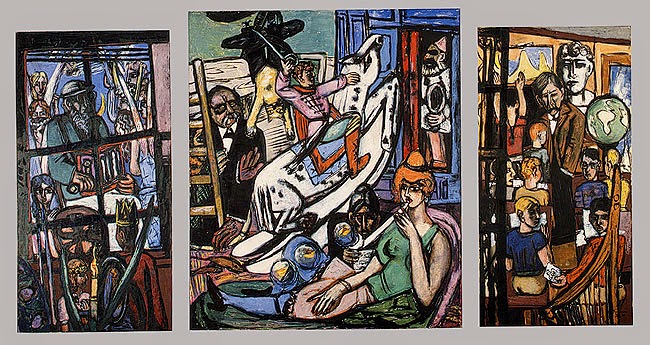
The Beginning by Max Beckmann

Beginning is a highly complex and enigmatic work, one that has been subjected to a wide variety of readings ever since it was first exhibit at the Buchholz Gallery in New York in 1949.

The Beginning is the eight of nine triptychs Beckmann produced during the last two decades of his life – between 1932 and 1950.

By using the triptych form, he makes reference to Late Gothic altarpieces that recorded the loved of martyrs and saints.

The three panels are autobiographical, dwelling on Beckmann’s childhood. The central panel shows a playroom where a little boy in military costume brandished a sword as he mightily rides a rocking horse.
The Beginning by Max Beckmann

Saturday, March 29, 2014

The Night Café by van Gogh

In 1888, he relocated to Arles in southern France, where he painted Night Café, one of his important and innovative canvasses.

A night café was an establishment, typically in the South of France. Van Gogh stayed up three nights to paint this picture, sleeping only during the day.

The Night Café was a picture of people seeking solace late at night, but in this case it was no warm and comforting refuge.
p
According to him, ‘I have sought to convey that the café is a place where one can ruin oneself, go mad, commit crime’.

In Night Café, van Gogh explored ways colors and distorted forms can express emotions. The thickness, shape and direction of his brushstrokes create a tactile counterpart to the intense color.
The Night Café by van Gogh

Monday, February 3, 2014

Woman in White of 1923 by Pablo Picasso

The model is Olga Koklova, and there is softness and refinement in both conception and rendering that differentiates this work from earlier drawing.

She is rendered with a much more delicate line and with less dramatic and forceful color.

Seated in a chair, with her arms crossed on her chest in casual fashion, she looks thoughtfully into the distance.

There is feeling of introspection and isolation about her, as if she exists in her own time and space, emotionally distant from the viewer.

It was painted in 1923. It is one of the best known of his classic period when Picasso made linear paintings of figures with Grecian heads.
Woman in White of 1923 by Pablo Picasso

Thursday, September 5, 2013

The Dinner Table by Matisse

It was painted in 1897. The painting was one do Henry Matisse’s first attempts at Impressionism.

The large size Dinner Table, which Matisse sent to the Salon of 1897, is a landmark because of its technical accomplishment, its textural density and its rich luminosity.

The Dinner Table is the locus of ceremony and symbolic, but nothing more dramatic appears to be taking place here than the clearing of the table by servant in white cuffs and apron.
The Dinner Table by Matisse

Saturday, February 28, 2009

No.5, 1948 by Jackson Pollock

No.5, 1948 by Jackson Pollock
No. 5, 1948 is a painting by Jackson, an American painter known for his contributions to the abstract expressionist movement.

The painting was done on an 8' x 4' sheet of fiberboard, with thick amounts of brown and yellow paint drizzled on top of it, forming a nest-like appearance.

It was originally owned by Samuel Irving Newhouse and displayed at the Museum of Modern Art before being sold to David Geffen.

It is claimed by the New York Times that this painting was sold by David Geffen (of Geffen Records), to David Martinez (managing partner of Fintech Advisory).

However, a press release issued on behalf of Martinez states that he didn’t actually purchase the painting.

So the truth is shrouded in mystery, and it can only be rumored to have sold for a record-breaking $140 million.
No.5, 1948 by Jackson Pollock

Thursday, January 15, 2009

Gustav Klimt – Portrait of Adele Bloch-Bauer 1

Gustav Klimt – Portrait of Adele Bloch-Bauer 1

This was sold by Maria Altmann, who – after a lengthy and complicated court battle – was deemed rightful owner of this Klimt and several others.

Altmann was named as an inheritor of the painting in the will of by the widowed husband of the model herself, despite the efforts of the Austrian State, as Adele Bloch-Bauer had originally left the painting to the State Gallery in her own will.

The painting was bought by Ronald Lauder for his Neue Galerie in New York, to be the centerpiece of a collection of Jewish-owned art rescued from the Nazi looting that took place in the Second World War.

In this greatest gold style paintings, Portrait of Adele Bloch-Bauer 1, Klimt flattened the woman’s dress so that it shares the same picture plane as the background.

Then he blended them together by merging the decorative dress with an equally decorative background.

Yet the dress is still distinguishable from the background. Actually, the painting has two backgrounds: a flat wall, and a golden membrane or ornamental cocoon wrapped around Ms. Bloch-Bauer.

Sinuous lines, swirls, and large and tiny squares distinguish the membrane from the dress, which is comprised of silver arrowheads, and gold pyramids with eyes in them. The latter give the impression that the dress is watching us.

But the woman’s face, neckline, hands and forearms are classically modeled, so that she emerges from the background and her own flattened body as three dimensional woman.
Gustav Klimt – Portrait of Adele Bloch-Bauer 1

Friday, December 26, 2008

Garçon à la pipe by Pablo Picasso


Garçon à la pipe by Pablo Picasso
So far the highest price a painting has ever fetched at auction (as the others were all sold privately), and was the first painting to break the $100 million barrier (it was sold in 2004). The strange thing is that it was never made public as to who expressed such an interest in Picasso’s portrait of a smoking Parisian.

Garçon à la pipe replaced Portrait of Doctor Gachet by Vincent Van Gogh which sold for a pittance of only $82.5 million.

The oil on canvas painting, measuring 100 × 81.3 cm (slightly over 39 × 32 inches), depicts a Parisian boy holding a pipe in his left hand. The boy in the painting was among the community of entertainers living in the Montmartre section of Paris. On May 5, 2004 it sold for $104.1 million USD at an auction in Sotheby's in New York, after having been given a pre-sale estimate of $70 million by the auction house.
Garçon à la pipe by Pablo Picasso

Thursday, December 4, 2008

Self portrait with Bandaged Ear by Vincent van Gogh


Self portrait with Bandaged Ear by Vincent van Gogh
It was painted within a short time of his having had a mental breakdown. During which he cut off part of his ear. The picture shows that van Gough must have mutilated his right ear, because it is clear this one that is bandaged in the picture. A moment’s reflection though, tells that it actually must have been his left ear that was cut, because the picture is a self portrait, carried out with him looking in a mirror and therefore inverting left and right.

Van Gogh’s self portrait makes the point that anything with asymmetry from left to right is distinct from its mirror image. But it turns out for us to be able to distinguish an object’s left and right, it also has to have asymmetries along two other axes. In the case of van Gogh’s picture, for example, these are the asymmetries from top to bottom and front to back.

He was hospitalized after the incident following an attack of his friend and then admitted himself to a mental hospital. Before that, he became very ill with heat stroke, fainting spells and seizures. In angers, he cut off part of his ear with his razor. After Vincent’s ear had healed sufficiently, his doctor advised him to avoid excitement and alcohol and to wear his hat in the sun.
Self portrait with Bandaged Ear by Vincent van Gogh

Thursday, November 13, 2008

Portrait of Adele Bloch-Bauer II


Portrait of Adele Bloch-Bauer II
Portrait of Adele Bloch-Bauer II was painted by Gustav Klimt. Gustav Klimt was on of the most prominent members of the Vienna Secession movement and born in July 14, 1862.

Portrait of Adele Bloch-Bauer II was painted in 1912, was one of several that he painted of wealthy members of the Viennese Jewish community. The care with which he has delineated Bloch-Bauer’s features gives a dimensionality that contrasts strikingly with the flat pattern of her garment.

The painting was sold to unknown buyer at a price of $87.9 million.
Portrait of Adele Bloch-Bauer II

Saturday, November 8, 2008

Triptych, 1976 Painted by Francis Bacon


Triptych, 1976 Painted by Francis Bacon
A new record for post war art was set as Francis Bacon’s Triptych, 1976 sold for USD86 million at a Sotheby’s auction in New York this year.

Francis bacon was born in Dublin in 1909 and died in Madrid in 1992.

The “Triptych” was painted by Francis Bacon in 1976. The two lateral panels depict a man whose oval head rests on a body that melts down into nondescript human fragments. In the central panels, ill defined body parts, possibly animal at the top and decidedly human in the lower area, hang down from the ceiling as if they made up some kind of chandelier.

Triptych, 1976 one of the most important works in Bacon’s oeuvre and a landmark of the 20th century canon. Triptych is one of the best and ranks among the greatest of Bacon’s paintings.

In Triptych, 1976, Bacon draws on Ancient Greek mythology to express his personal tragedy. In the central panel Bacon alludes to the legend of Prometheus, who as a punishment from Zeus is bound to a rock where his liver is perpetually devoured by an eagle. It is also modern day interpretation of Aeschylus’ famous trilogy The Orestia. To avenge the death of his father at the hands of his mother, Orestes commits matricide and is plagued by the three Furies, the manifestation of guilt.
Triptych, 1976 Painted by Francis Bacon

Friday, October 24, 2008

Vincent van Gogh – Portrait of Dr. Gachet


Vincent van Gogh – Portrait of Dr. Gachet
Dr. Gachet was a physician who treated him in his last illness. He had painted the doctor and said, with the “heartbroken expression of out times.” Van Gogh viewed Doctor Gachet as a melancholy, thoughtful man.

Portrait of Dr. Gachet was painted six weeks before Van Gogh committed suicide in 1890. Dr. Paul Ferdinand Gachet was Homeopathic doctor and tended Van Gogh before his death.

The painting was sold at record $82.5 million to a Japanese buyer in May 15, 1990.
Vincent van Gogh – Portrait of Dr. Gachet

Thursday, October 9, 2008

Le Moulin de la Galette by Pierre Auguste Renoir


Le Moulin de la Galette by Pierre Auguste Renoir
It is the most expensive painting. The cost was $78,100,000 in 1990. It was painted by Pierre Auguste Renoir’s. His art celebrates life’s temporal pleasures, the ‘here and now’ of his time, more than any other impressionist artist. He preferred to paint his friends and lovers.

His masterful depictions of their candid facial features and body stances convey the youthful spirit and intimate charm that ignited the feeling of an Eden of earthly pleasures.

Pierre Auguste Renoir’s liked to go there to paint the common Parisians living and loving in the afternoon sun. The sunlight filtering though the trees creates a kaleidoscope of colors, like the 19th century equivalent of a mirror ball throwing darts of light onto the dancers.

He captures the dappled light with quick blobs of yellow staining round, the men’s jackets, and the sun –dappled straw hat. The painting glows with bright colors. Even the shadows on the ground, which should be gray or black, are colored a warm blue.

Renoir’s work is lighthearted, with light colors, almost pastels. He seems to be searching for n ideal, the pure beauty on the ground floor.
Le Moulin de la Galette by Pierre Auguste Renoir

Thursday, August 28, 2008

Mona Lisa


Mona Lisa
Also known as La Giocondo is a portrait of the wife of Francesco del Giocondo. The painting was painted by Leonardo between 1503 and 1505. It was painted in oil on a poplar panel.

It was sold to Francois I. It was greatly admired and considered the prototype of the Renaissance portrait.

The painting is half length portrait and depicts a woman whose expression is often described as enigmatic. Mona Lisa has slight smile which enters into the gentle, delicate atmosphere pervading the whole painting. This because Leonardo uses the sfuma technique, a gradual dissolving of the forms themselves, continuous interaction between light and shade and an uncertain sense of the time of the day.

Mona Lisa dressed on the Florentine fashion of her day and seated in a visionary, mountainous landscape. Mona Lisa subject has been adapted in turn as an aesthetic, philosophical and advertising symbol, entering eventually into the irreverent parodies of the Dada and Surrealist artists.
Mona Lisa

Sunday, August 3, 2008

Mustard Race Riot by Andy Warhol


Mustard Race Riot by Andy Warhol
Mustard Race Riot is a painting about civil rights protests in Alabama, United States, in the 1960s. It was sold $15.1 million in 2004. The painting depicts violence in Birmingham on one large panel, with a blank adjoining panel. Mustard race Riot was inspired by three photographs of police attacks on civil rights demonstrators in May 1963. In this painting Warhol transforms terrifying image of policeman and their dogs confronting civil rights demonstrators.
Mustard Race Riot by Andy Warhol

The Most Popular Posts

Arts & Culture | Smithsonian

Society and Culture