Showing posts with label James Collinson. Show all posts

Wednesday, November 5, 2025

“Too Hot” (1863): A Glimpse into Victorian Domestic Warmth

Published in The Illustrated London News on February 28, 1863, Too Hot was one of the most popular color engravings of its time. The print, produced by the skilled firm Leighton Brothers, was created after a painting by James Collinson, a British artist known for his gentle moral narratives and meticulous attention to detail. Issued as a special Christmas supplement for subscribers, it appealed to Victorian readers who cherished sentimental depictions of family life and rural simplicity.

The scene in Too Hot is a charming slice of domestic life. A kindly grandfather cools a spoonful of soup—or perhaps tea—for his young granddaughter, who sits trustingly on his knee, her expression caught between eagerness and restraint. The title captures both the literal moment and the metaphorical lesson unfolding within it: patience, care, and intergenerational affection. Such genre scenes were popular in mid-nineteenth-century Britain, reflecting the moral ideals and family values central to Victorian culture.

James Collinson, who designed the original image, was one of the founding members of the Pre-Raphaelite Brotherhood, a group of artists formed in 1848 who sought to revive the sincerity and precision of early Renaissance art. Collinson left the Brotherhood in 1850 after converting to Roman Catholicism and training briefly for the priesthood at Stonyhurst College. By the 1860s, he had returned to London, married, and turned toward painting more conventional subjects. His works from this later period often celebrated quiet virtues, domestic tenderness, and the beauty of everyday life.

In Too Hot, Collinson’s Pre-Raphaelite sensitivity remains evident in the finely rendered textures, the thoughtful characterization, and the luminous atmosphere that unites the figures. Though modest in scale, the image reveals a deep empathy for ordinary people and their intimate moments of connection. 

More than a simple domestic vignette, Too Hot embodies the Victorian ideal of warmth—both emotional and literal—captured through the steady hand of an artist who saw holiness in the small rituals of daily life.
“Too Hot” (1863): A Glimpse into Victorian Domestic Warmth

Saturday, January 6, 2024

The Sisters (c. 1860) by James Collinson

The painting, crafted on a canvas with dimensions of 60.96 cm × 50.8 cm, is from the mid-19th century and is the work of James Collinson, a significant figure in the Pre-Raphaelite Brotherhood from 1848 to 1850. Importantly, Collinson was one of the seven original members who founded the Pre-Raphaelite Brotherhood.
The Sisters (c. 1860) by James Collinson

Wednesday, May 3, 2023

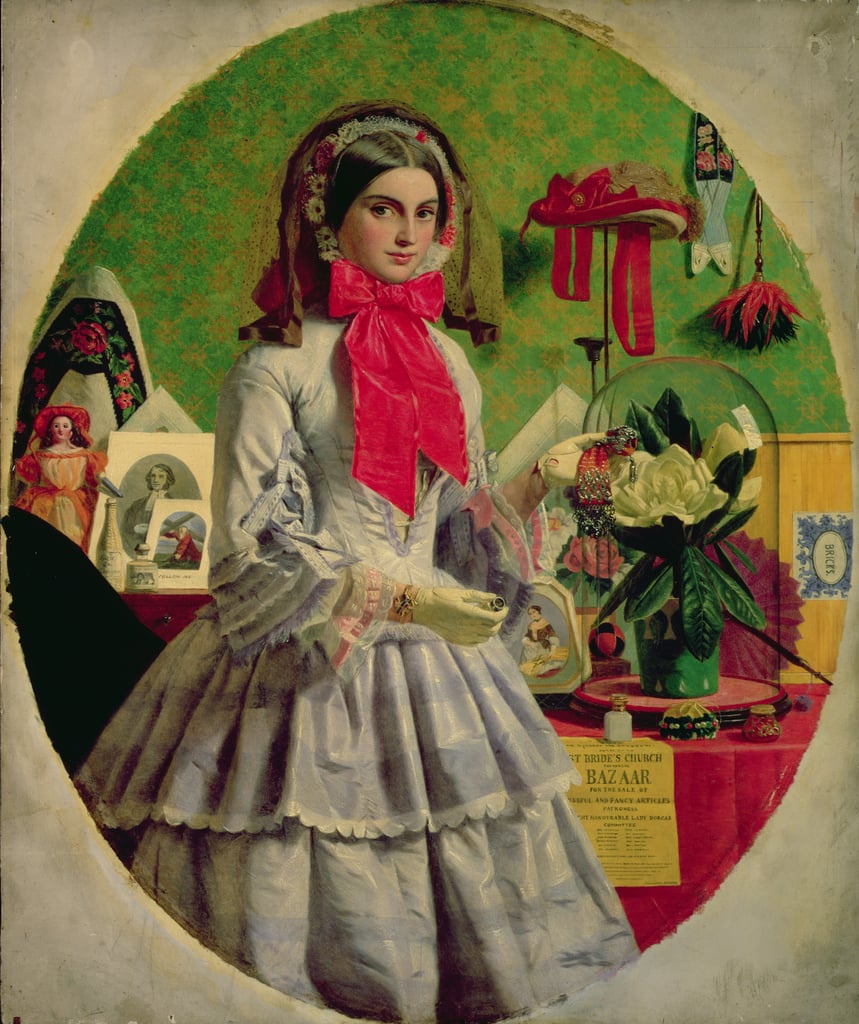
At the Bazaar (1857) by James Collinson

At the Bazaar or The Empty Purse painting dates to 1857. The painting depicts a fashionably dressed woman at a bazaar who is holding a red, beaded miser’s purse with beaded tassels in her left hand.
At the Bazaar (1857) by James Collinson

Wednesday, April 6, 2022

The Landlady by James Collinson

The Landlady was painted in 1856. The oil painting on canvas advertises “furnishes apartments” on the window; note too the venetian blinds and geraniums, familiar signals of Victorian.

James Collision ostensibly shows a landlady at a window, about to let a room to an observed tenant, subliminally, or perhaps no so subtly it suggests that she, too, is “to let” and hence represents another inversion painting like Hunt’s “Awakening Conscience.” James Collinson (1825–1881) was a Victorian painter who was a member of the Pre-Raphaelite Brotherhood from 1848 to 1850.
The Landlady by James Collinson


Wednesday, December 1, 2021

Home Again (1856) by James Collinson


Home Again was painted by James Collinson in the final year of the Crimean War (1854-1856).

A weary soldier wearing the uniform of the Coldstream Guards is returning home to his rural cottage. When it was first exhibited a quotation beside the painting explained that the soldier had been discharged because of an accident leading to blindness.

James Collinson (1825-1881) an English Victorian painter was one of the founding members of the Pre-Raphaelite Brotherhood who left the group and gave up painting. He was born at Mansfield, Nottinghamshire and was the son of a bookseller. He entered the Royal Academy School, and was also a fellow-student with Holman Hunt, and Dante Gabriel Rossetti.
Home Again (1856) by James Collinson

Monday, June 29, 2020

A Son of the Soil (1856) by James Collinson

James Collinson (9 May 1825 – 24 January 1881) was a Victorian painter who was one of seven founder members of the Pre-Raphaelite Brotherhood, a group of painters in mid-Victorian Britain.

In this painting we see a young man considering whether to sign up for the Army Work Corps in the Crimea, during the Crimean War (1853-1856). The Army Work Corps was set up to provide support to the army in the Crimean war. The rough territory in the war zone, which was on the Crimean Peninsula and around the Black Sea, had no proper roads, and no railway to transport troops and supplies.

The man’s face looks weather-beaten. One of his fingers points t0 two coins on the table. ‘A Son of the Soil’ probably shows a story that contemporary people would have found easy to read.
A Son of the Soil (1856) by James Collinson

Tuesday, December 3, 2019

Answering the Emigrant's Letter (1850) by James Collinson

The painting shows cottage scene of a family, a man, woman, three children and baby, seated round a table in the corner of the room, writing a letter.

A family gathered together to write back to a friend or relation who has emigrated to Australia. Over a million people had emigrated in the ten years before Collins painted this picture. Hence, it was a subject of great interest to the public.
Answering the Emigrant's Letter (1850) by James Collinson

Tuesday, October 22, 2019

The Renunciation of St. Elizabeth of Hungary (1850) by James Collinson

James Collinson-(May 9, 1825 –January 24, 1881) An English Victorian painter who was one of the founding members of the Pre-Raphaelite movement. He was attracted to the devotional and religious aspects of Pre-Raphaelitism. The Renunciation of St. Elizabeth of Hungary was painted in 1850.

The Most Popular Posts

Arts & Culture | Smithsonian

Society and Culture